
How a new addition to our rehabilitation program is helping us explore the connection between comfort, movement, and recovery.
At EERC, we've learned that healing rarely follows a straight line. Every horse arrives with a different history, a different injury, and a different path toward recovery. Some respond quickly to conventional treatments, while others challenge us to look beyond the obvious, explore new approaches, and find the right combination of therapies to support their recovery.
Our philosophy has always been to treat the whole horse rather than focus solely on an injury. Pain, movement, muscle tension, and the nervous system are deeply interconnected. An injury in one part of the body can create compensatory patterns elsewhere, sometimes long after the original trauma has begun to heal. Understanding those connections has become an essential part of how we approach rehabilitation.
Recently, we introduced a new tool to our program: Pulsed Electromagnetic Field (PEMF) therapy. Although we're still learning about its applications, our early experiences have been encouraging, particularly with one of our rehabilitation horses, Maverick.
What Is PEMF Therapy?
PEMF therapy is a noninvasive treatment that uses controlled pulses of electromagnetic energy to interact with tissues within the body. These pulses induce small electrical effects in tissues and may influence certain cellular processes associated with inflammation, pain, and tissue repair.
The concept is fascinating because our bodies, and those of our horses, rely on electrical activity for countless biological functions. Nerve communication, muscle contraction, and cellular signaling all involve electrical processes. PEMF therapy is being studied for its potential to influence some of these processes in ways that could support healing and comfort.
Research has explored PEMF's possible role in managing musculoskeletal discomfort, influencing inflammatory responses, and supporting tissue recovery. Some studies have reported promising results, particularly in certain applications involving pain and bone healing. However, the scientific evidence in horses remains limited, and researchers have not established consistent benefits across injuries or treatment protocols.
For us, PEMF represents another potential tool in our rehabilitation program, one that may complement veterinary care, therapeutic exercise, and the natural healing process rather than replace them.
Maverick: Learning to Move Freely Again
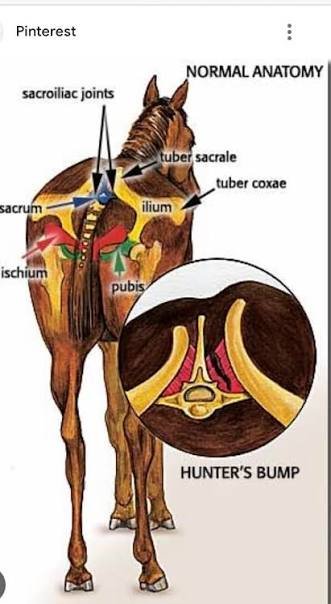
Pelvis Subluxation
Can lead to hunters bump.
Maverick's rehabilitation journey has been one of our more complex cases. After suffering a pelvic fracture and subluxation, his recovery has required careful management, patience, and a gradual approach to rebuilding strength and coordination. Because the pelvis plays such an important role in transferring power from the hindquarters through the rest of the body, an injury of this nature can affect nearly every aspect of a horse's movement.
As Maverick recovered, we continued to see the effects of compensation and protective movement patterns. Like many horses recovering from significant trauma, he had learned to guard areas of discomfort, creating tension and restricting the natural movement of his body. Our rehabilitation program has focused on helping him regain strength, stability, and confidence through controlled hand-walking, proprioceptive exercises, and other supportive therapies.
Since introducing PEMF, we've observed some particularly encouraging changes in Maverick. He appears more comfortable moving through his hindquarters, with less guarding around his pelvis and greater freedom in his stride. His walk has become more relaxed, and we've noticed an overall softening throughout his body. Perhaps most interesting is his general demeanor. He seems more settled, more willing to relax, and less inclined to hold the protective tension that has accompanied so much of his recovery.
These observations have been especially meaningful because relaxation is such an important component of rehabilitation. A horse experiencing discomfort may remain in a heightened state of vigilance, continually bracing against movement or anticipating pain. When that tension begins to ease, we often see changes not only in how the horse moves but also in how it interacts with its surroundings and approaches physical activity.
We cannot say with certainty how much of Maverick's improvement is attributable to PEMF rather than the combination of therapies and natural healing already underway. What we can say is that the changes we've observed since adding it to his program have been encouraging. For a horse who has faced such a complicated recovery, seeing greater comfort, freedom of movement, and an ability to relax is a meaningful step forward.
The Relationship Between Pain, Movement, and the Nervous System
One of the most interesting aspects of equine rehabilitation is understanding how the nervous system responds to injury. Pain serves an important protective function, signaling the body to avoid movements that could cause further damage. Muscles tighten, weight shifts, and movement patterns change to protect vulnerable structures. These adaptations are necessary during the early stages of healing, but they can become problematic when they persist after the original injury has stabilized.
Over time, a horse may develop habitual patterns of compensation. A restricted pelvis may affect the back, shoulders, and even the way the feet contact the ground. Muscles that have been working overtime become tense and fatigued, while others lose strength through reduced use. The result is a body that may be physically healing but has not yet rediscovered how to move comfortably and efficiently.
This is where our interest in combining therapeutic modalities with proprioceptive training becomes especially important. Proprioception is the body's ability to sense where it is in space and coordinate movement without consciously thinking about every step. Through carefully selected groundwork, controlled movement, and repetition, we can help horses develop better body awareness and establish more coordinated movement patterns.
We are interested in whether PEMF may help some horses become comfortable enough to participate more freely in that process. Although research has not established that PEMF directly restores proprioception or retrains nervous system pathways, improving comfort may create better conditions for therapeutic movement. When a horse is less guarded and more willing to move, we have greater opportunities to work on the strength, balance, and coordination needed for long-term recovery.
In Maverick's case, the relaxation we've observed is just as interesting to us as the changes in his movement. A softer body and a calmer demeanor may allow us to approach his rehabilitation exercises with less resistance and more productive movement.
Why We Believe in a Multimodal Approach
If there is one thing years of working with rehabilitation horses have taught us, it's that there is rarely a single answer. Two horses with similar diagnoses may respond very differently to the same treatment, and what works beautifully for one may offer little benefit to another. Successful rehabilitation requires us to continually observe, reassess, and adapt our approach to the individual horse.
Our program incorporates veterinary treatment, corrective farrier work, targeted exercise, laser therapy, bodywork, and other supportive modalities. Each addresses a different aspect of recovery, but none can accomplish everything on its own. A carefully balanced hoof can change the way forces travel through the body, while therapeutic movement can help rebuild strength and coordination. Managing discomfort may allow a horse to participate more comfortably in those exercises, creating opportunities for continued progress.
PEMF is now another part of that toolbox. We are particularly interested in exploring how it may complement the work we're already doing with horses recovering from musculoskeletal injuries and the compensatory patterns that often accompany them.
As with any rehabilitation treatment, we believe the most valuable information comes from the horse itself. We pay attention to changes in movement, willingness, muscle tension, posture, and overall demeanor. We also recognize that a positive response during one session doesn't necessarily translate into lasting improvement. Consistent observation over time is what helps us determine whether a treatment is contributing to meaningful progress.
A New Tool, Not a Shortcut
New technology can be exciting, especially when it offers another possibility for horses facing difficult recoveries. But rehabilitation isn't about finding a machine that can do the healing for us. It is about understanding what each horse needs and creating an environment in which the body has the best possible opportunity to recover.
PEMF does not replace proper veterinary diagnosis, appropriate rest, corrective farrier care, or the progressive exercise necessary to restore function. Nor does it eliminate the importance of time. A fractured bone still needs to heal, weakened muscles still need to regain strength, and movement patterns developed through months of compensation still require careful retraining.
What PEMF may offer is another way to support comfort during that process. Our experience with Maverick has encouraged us to continue exploring its potential while remaining mindful of the limitations of current research.
Rather than viewing it as a miracle treatment, we see it as an opportunity to ask better questions. Can we help a horse become more comfortable during recovery? Can we reduce the protective tension that may interfere with movement? Can we create better conditions for the therapeutic exercises that ultimately help restore strength and function?
These are the questions that guide our work, and they're the reason we're excited to continue incorporating PEMF into our rehabilitation program.
Healing Is a Partnership
Perhaps the greatest lesson horses teach us about healing is that it cannot be forced. We can provide thoughtful veterinary care, supportive therapies, balanced nutrition, and carefully designed exercise programs, but we must ultimately respect the body's ability to recover at its own pace. Some days bring noticeable improvements, while others remind us that progress is rarely linear.
Maverick's journey is a wonderful example of that patience. His recovery has required us to continually adjust our expectations, celebrate small victories, and recognize that sometimes the most significant changes are not dramatic. A softer expression, a more relaxed walk, or the willingness to move without bracing can tell us that a horse is beginning to feel more comfortable in its own body.
Our early experience with PEMF has given us another reason to be hopeful. We're looking forward to learning more about how this therapy may complement our existing rehabilitation methods and sharing those observations as we continue working with the horses in our care.
At EERC our goal has never been simply to heal an injury. It's to help the whole horse recover, physically and mentally, so they can return to a comfortable and purposeful life.
Sometimes that means trying a different approach, looking beyond conventional solutions, or adding another tool to our program. And sometimes, the most encouraging sign of progress is simply watching a horse who has spent months protecting himself finally begin to relax.
Because healing isn't just about what the body can do again. It's also about how comfortable the horse feels doing it.